
An Iranian VMS for organizations that will not depend on foreign infrastructure
Arisa is a fully domestic video management and surveillance platform. Every frame and every record stays on your own infrastructure, nothing about running it depends on an outside service, and support is available in Persian during Iranian business hours. Up to ten thousand multi-brand cameras, entirely in the browser.
Buying domestic is not a slogan. It is a risk decision
A surveillance platform is infrastructure, not office software. It runs for years, grows steadily, and has to work on the day you finally need it. These four things are where dependence on a foreign supplier shows up.
Your service does not hinge on someone else's decision
When surveillance runs on a foreign product, whether it keeps running depends on conditions none of which are yours to control. Arisa runs entirely on your own infrastructure and needs no outside connection to work. What happens beyond your organization does not take your cameras off the air.
Support in your language, in your working hours
In a several-hundred-camera system, questions come up. The difference between an answer the same day and a ticket written in English waiting on a time difference shows up, in practice, as downtime. Arisa support is Persian speaking and reachable from inside the system itself.
The platform follows your needs, not a foreign roadmap
Every organization has one requirement the off-the-shelf product does not cover: a particular report, a link to an internal system, an alarm rule that only makes sense in your work. When the vendor is reachable, those are possible. Arisa also has a plugin framework and an open API, so your own engineers or your contractor can build on it.
Suited to public and enterprise procurement
In much of enterprise and government purchasing, a domestically produced product is either a requirement or a scoring advantage. Arisa is an Iranian product, which keeps procurement simple: a domestic contract, a proper invoice, and direct dealing with the people who build it - no intermediary and no foreign-currency payment.
Arisa compared with foreign platforms
What is compared here is how well each option fits an Iranian organization: how supply and support work, how far the platform scales, and how an operator connects to it. By foreign enterprise platforms we mean products such as Genetec and Milestone, the ones most often encountered in large domestic projects.
| Arisa | Foreign enterprise platforms such as Genetec and Milestone | Free camera-vendor software | |
|---|---|---|---|
| Persian support in Iranian business hours | Yes, direct from the vendor | Through a reseller, usually in English | Effectively none |
| Domestic supply and contracting | Yes | Depends on an intermediary and foreign currency | Comes with the hardware |
| Keeps working with no outside dependency | Yes, fully offline | Depends on the supplier's terms | Often tied to the vendor's cloud |
| Runs in a browser with no client to install | Yes | Usually needs a desktop client | Needs installing on every machine |
| Scales to several thousand cameras | Yes, to ten thousand across a cluster | Yes | No |
| Customer can extend it | Yes, plugins and an open API | Limited and expensive | No |
Drag the table sideways to see every column.
"Free camera-vendor software" means the tools bundled with cameras, usually free and built for that one brand.
Not one more Iranian platform. A newer generation of one
Being domestic is the baseline now, not the advantage. The real difference is architecture: how the system grows, how an operator connects to it, and what happens when something breaks.
Nothing gets installed on an operator's machine
Arisa is entirely web based. An operator opens the address in a browser and works. Adding a viewing station costs nothing to install, an update is applied once on the server and everyone has it, and a security manager can check live video and alarms from their phone.
Start on one server, grow to ten thousand cameras
The platform is built as a cluster: one core server and as many nodes as needed. Recording and analytics load is spread across them, and if a node goes down its cameras move to healthy nodes automatically so recording continues. You do not have to buy for the largest case on day one.
Analytics as separate modules
Plate reading, face recognition, people counting, crowd analysis and smoke and fire detection are each a separate module, added when they are needed. You do not pay for a capability you are not using, and each module can be enabled only on the cameras that need it.
Maps and floor plans without internet
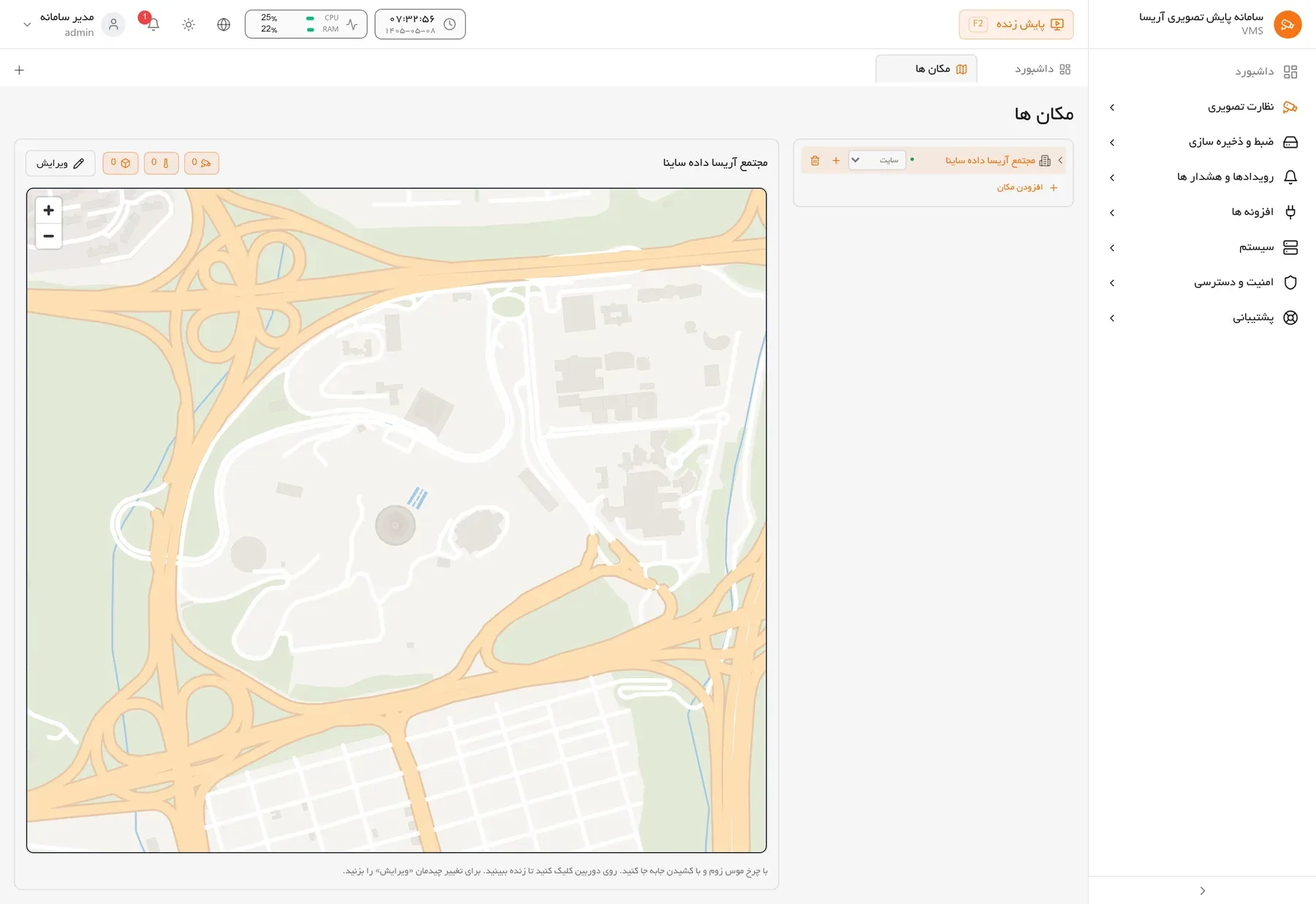
Camera positions are shown on a map of Iran and on building plans, and everything - the map included - lives on your own server. The map works on a completely closed network, which is not possible when the map comes from an external service.
Open to extension
A plugin framework and an open API let your engineers or your contractor build new capability and wire the platform into access control, fire alarm and enterprise systems. Where a tender requires that the customer be able to extend the system, this is a requirement rather than a bonus.
Built for Persian
The whole interface is Persian and right-to-left, dates are Jalali and numbers appear in familiar form. This is not a translation layered onto a foreign product; it was designed this way, and an operator with no English works with it comfortably.
What a technical manager wants to know
A technical summary for a first assessment. For a closer look at your particular project, use the form at the bottom of this page.
Features-
Cameras and protocols
Any network camera speaking ONVIF or RTSP, whatever the brand. Existing NVRs can be attached as video sources too, so earlier investment is not written off.
-
Live streaming
Live video in the browser over WebRTC, with no plugin and no installation. Under half a second of latency on a gigabit local network with H.265.
-
Recording and archive
Retention is set per camera or camera group. Continuous, motion-based or event-based recording. You are warned as storage approaches its threshold, and the oldest footage is removed automatically so recording never stops.
-
Scale
From a single standalone server to a cluster of nodes, up to ten thousand cameras. Load distribution across nodes can be automatic, semi-automatic or manual.
-
Platform
Server on Linux or Windows Server, plus a ready-made Ubuntu appliance. On the user side all that is needed is a modern browser - Windows, Linux, macOS, phone or tablet.
-
Health monitoring
Servers, disks, cameras and network equipment are monitored continuously, including over SNMP, with warnings before a situation turns critical.
Three sizes, three shapes of deployment
These three are illustrative, included to show what deployment looks like at different sizes. The numbers for your project come out of a sizing conversation.
Pilot, around 50 cameras
One building, one standalone server, no extra nodes. Suited to getting started and evaluating the platform before a larger decision. Analytics can be enabled on a few key cameras.
Enterprise deployment, around 500 cameras
A core server with several nodes sharing the recording and analytics load. A control room with several viewing stations, rule-based alarms and role-based access for different parts of the organization.
Multi-site infrastructure, 5,000+ cameras
Several sites across several cities, each with local nodes, all under one control centre. Recording happens locally so intercity bandwidth is not consumed, with monitoring and search from the centre.
From your current system to a domestic one, without stopping work
The common worry for organizations moving to a domestic platform is not whether the product is good. It is how much disruption the move causes and whether everything has to be thrown away. Short answer: no, and it does not have to happen overnight.
The cameras stay where they are
Any network camera speaking ONVIF or RTSP connects to Arisa, so in most projects no camera is replaced. Existing NVRs can remain as video sources, keeping the investment already made.
Start with one part, not the whole organization
The usual path is to move one building or one branch across and leave the rest as they are. Once the security team is comfortable and has seen the result, the remaining cameras follow gradually. There is no window in which the organization is left unwatched.
Operators have little to learn
Because the system opens in a browser and the interface is Persian and right-to-left, operator training is usually a single session. Nothing is installed on anyone's machine, so IT is not distributing software to dozens of desktops either.
The interface your operators work in
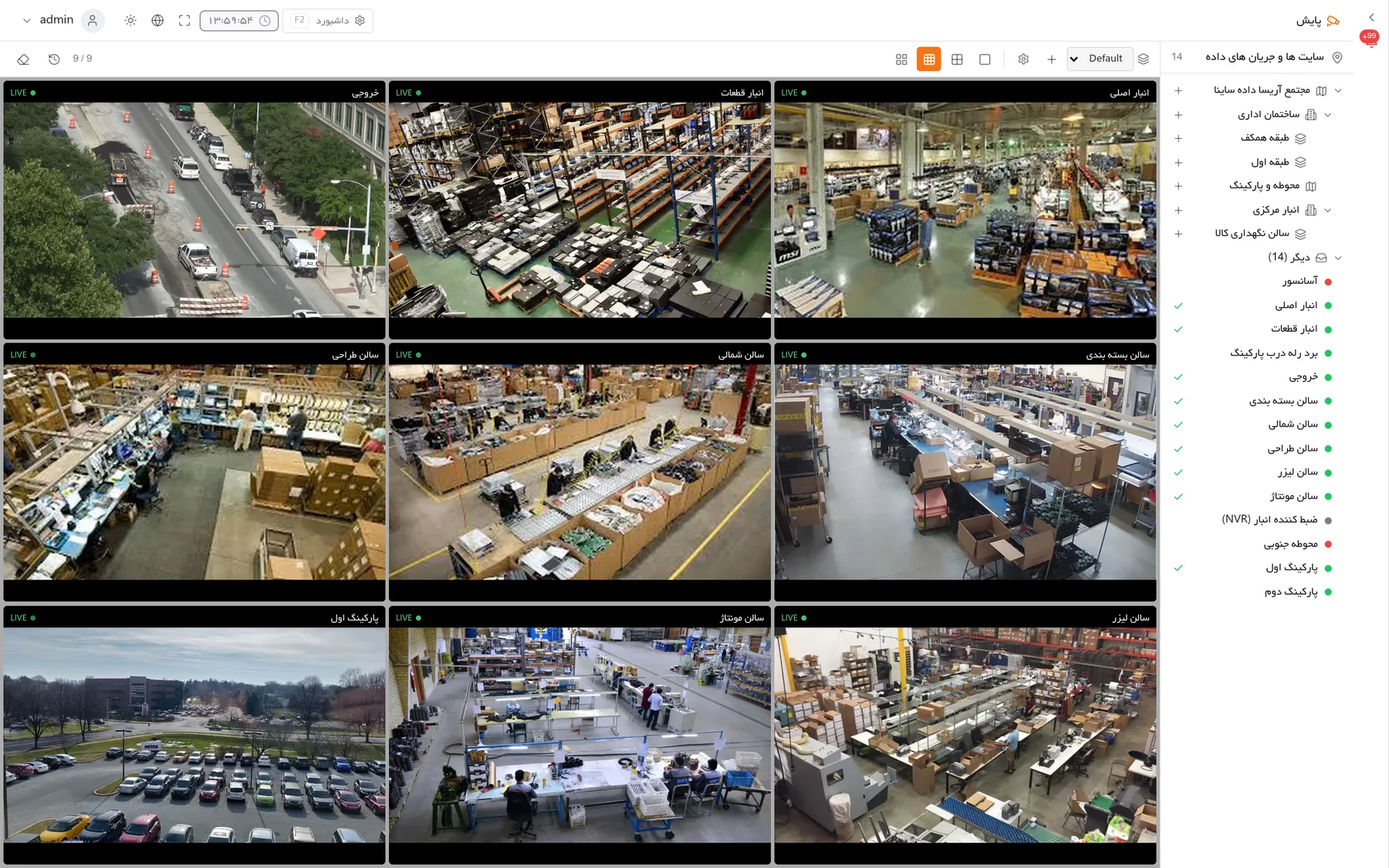
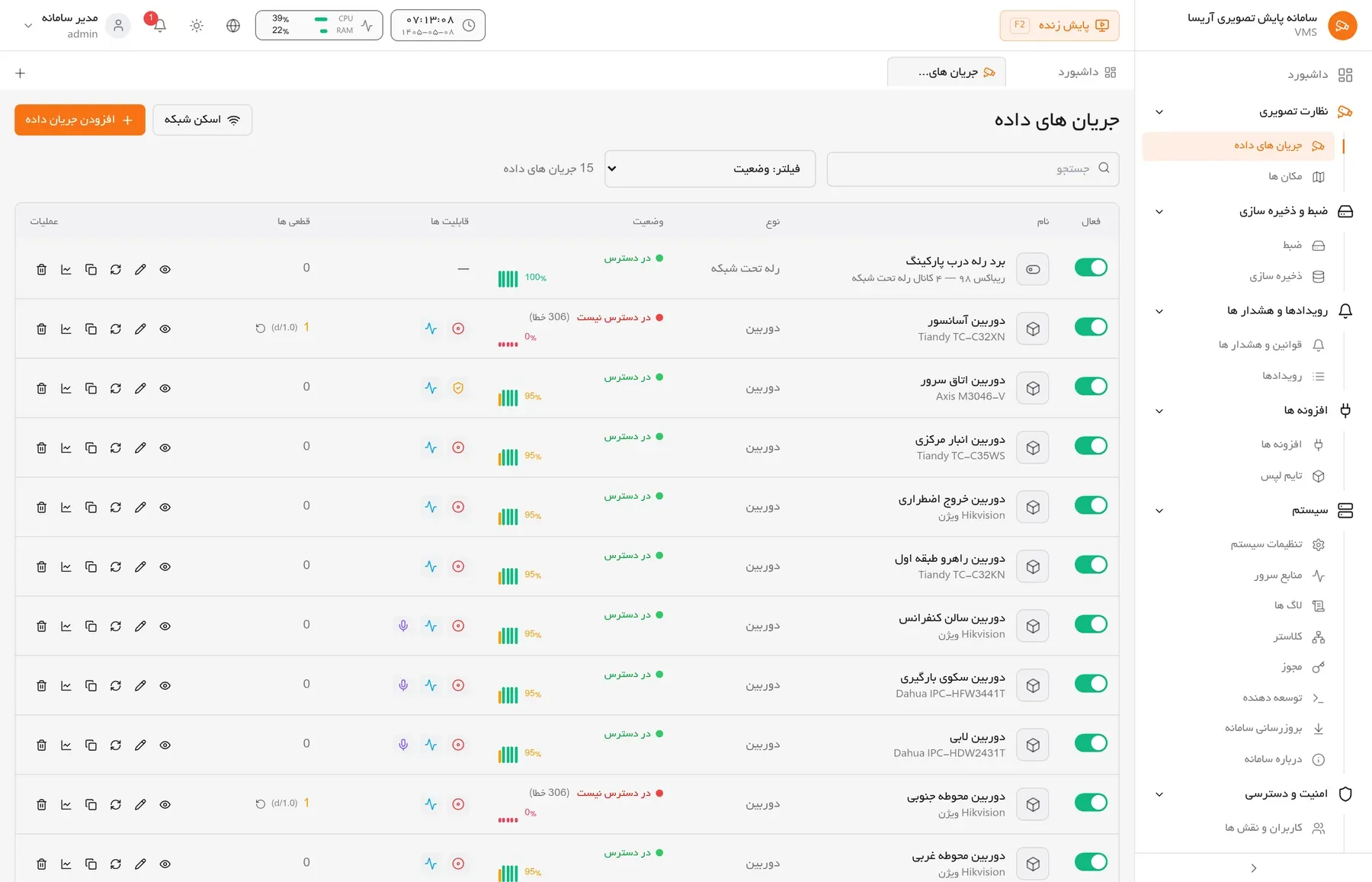
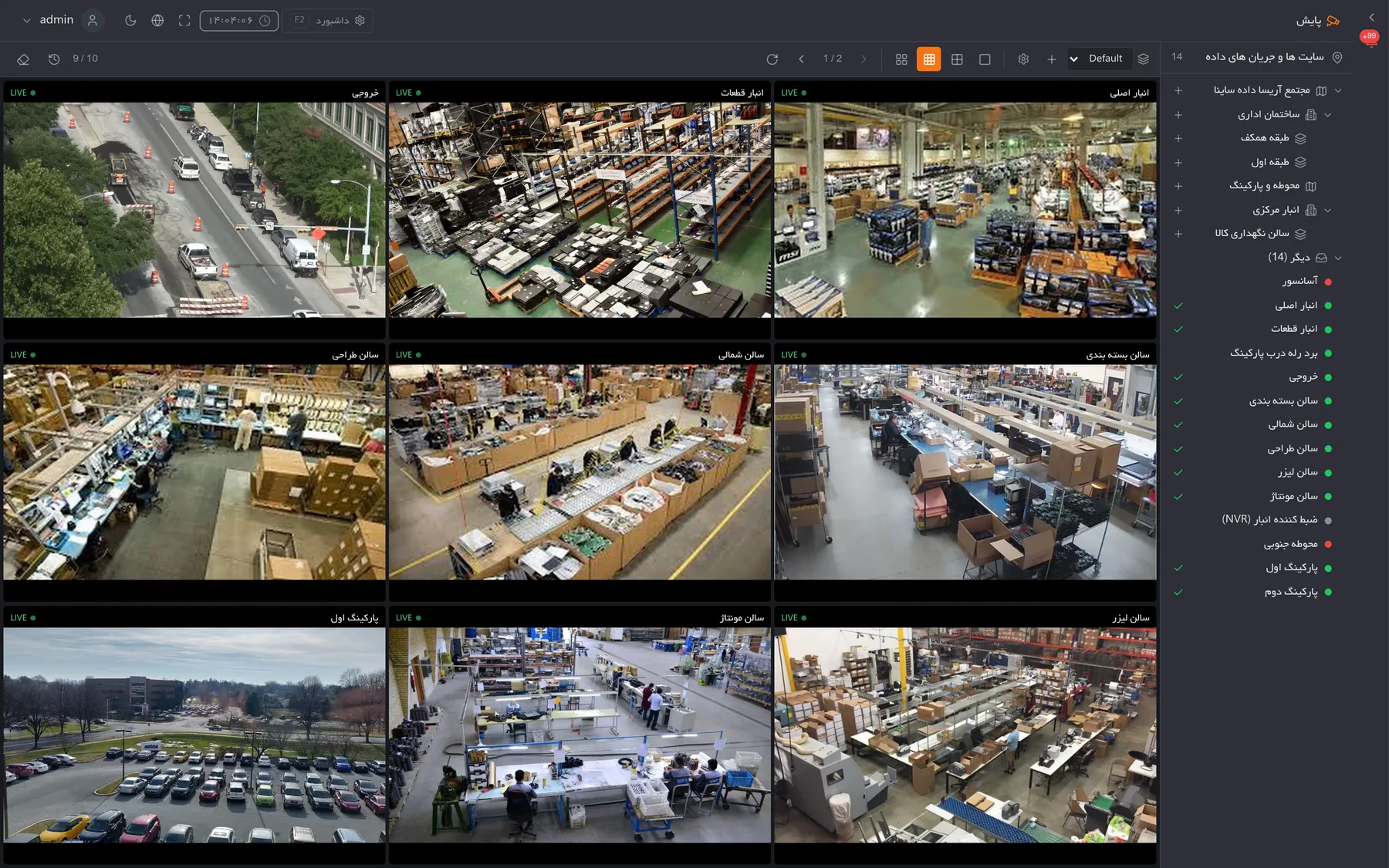
The images below are real views of the Arisa interface in operation. Every one of these screens runs in a browser, and the interface is Persian and right-to-left.
What enterprise buyers ask
Let us size your project
A few short questions about camera count, retention and number of sites. An engineer reads the answers and prepares a proposal for your project.
- An engineer reads your answers, not an autoresponder.
- Only name and phone are required. Fill in as much of the rest as you know.
- A summary of what you send is shown back to you straight away.
How would you rate Arisa?
One click on a star. No sign-up needed.
Rated 5.0 out of 5